
The future of port innovation will not be shaped only by large-scale electrification projects or new energy infrastructure. It will also depend on the ability to rethink what is already there, and to turn existing systems into smarter, more efficient, and more sustainable assets.
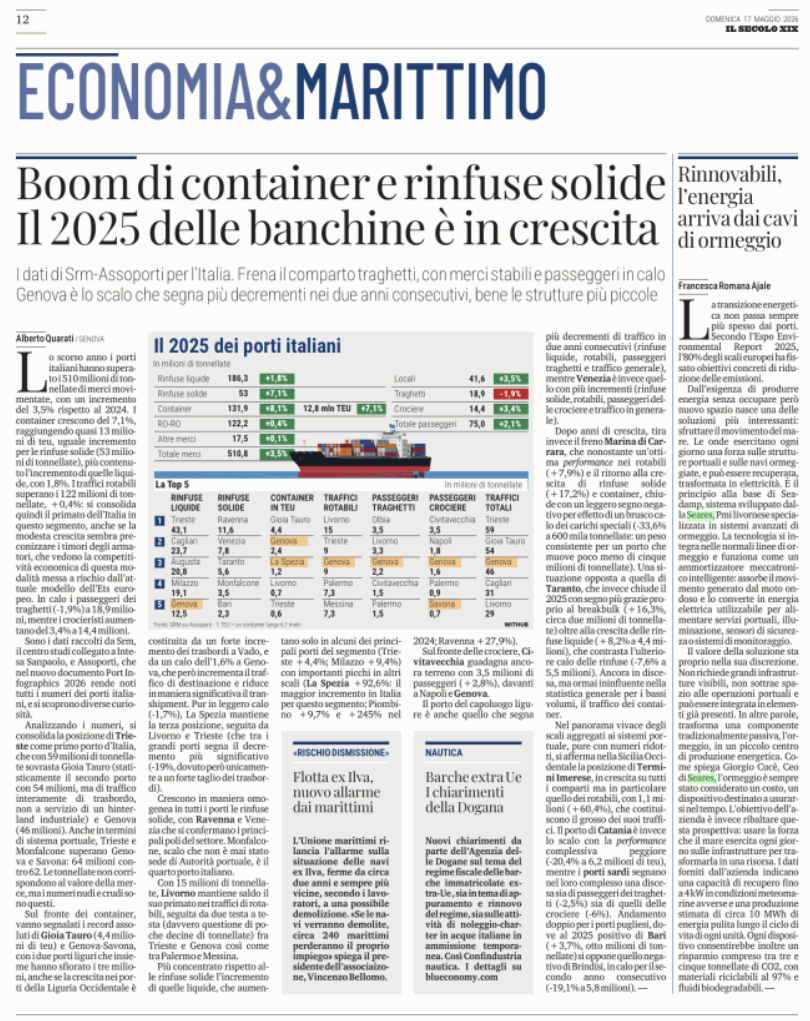
This is exactly the perspective highlighted in the article published by Il Secolo XIX, which points to a particularly interesting direction for the maritime sector: transforming mooring systems from passive infrastructure into active components capable of generating value.
For Seares, this is more than a technological concept. It is a concrete design vision. Traditionally, mooring systems have been developed to absorb stress, protect structures, and ensure safety under dynamic marine conditions. Their role has always been essential, but largely passive. Today, that same interaction between sea movement and port infrastructure can be interpreted in a completely different way.
The force generated every day by waves and vessel motion does not have to be seen only as something to manage. It can also become a resource.
This is where Seares’ approach takes shape. By integrating intelligent mechatronic technology into mooring lines, it becomes possible to recover part of the energy produced by marine motion and convert it into usable electrical power. In practical terms, this opens up new opportunities for ports, marinas, and coastal infrastructure, allowing energy to be used for sensors, monitoring systems, safety devices, and a range of port services that increasingly rely on distributed and reliable power sources.
What makes this approach especially relevant is not only the energy recovery itself, but the broader shift in mindset behind it. The point is not simply to add another technology layer to existing infrastructure. The point is to make infrastructure more responsive, more intelligent, and more capable of contributing to operational efficiency and environmental responsibility at the same time.
In this sense, innovation does not necessarily mean building more. Sometimes it means extracting more value from what is already part of the system.
That is why this vision fits so naturally into the wider evolution of the blue economy. Ports and marinas are under growing pressure to become more efficient, more resilient, and more sustainable. They need solutions that support digitalization, improve monitoring, reduce environmental impact, and help infrastructure perform better over time. Technologies that can integrate smoothly into existing contexts, without adding unnecessary complexity, are likely to play a key role in that transition.
This is also what makes the concept so compelling from an environmental perspective. Using marine motion as an energy source means working with a force that already exists, rather than introducing entirely new systems that may require additional space, resources, or structural changes. It is a quiet form of innovation, but one with very concrete implications.
The article also reflects another important aspect of Seares’ work: the ambition to rethink the relationship between maritime infrastructure and the sea itself. Not as a constant opposition between structure and force, but as a more intelligent interaction in which the natural dynamics of the environment can be turned into part of the solution.
That shift matters. Because the future of ports will not be defined only by how well they resist complexity, but by how well they learn to work with it.
At a time when the maritime sector is being called to balance operational performance with sustainability goals, this kind of thinking becomes increasingly valuable. It suggests that the next generation of port infrastructure may not simply be stronger or more connected, but also more adaptive, more resource-aware, and more capable of turning everyday marine dynamics into tangible benefits.
For Seares, this is the path forward: designing technologies that improve safety and performance, while helping ports and marinas move toward a more intelligent and responsible model of growth.
The sea has always been a force to navigate. Increasingly, it may also become a force to harness.